Saint Juan Diego statue
Blood CanticleThe Saint Juan Diego statue is a painted devotional figure whose importance grows from a personal token into the sign of a miracle for Oberon. Bearing the familiar image of Our Lady of Guadalupe and the roses associated with Juan Diego’s story, it links the novel’s reflections on sainthood and faith to the island rescue, and ultimately gives Oberon a tangible reason to feel safe and free.
Image and devotional background
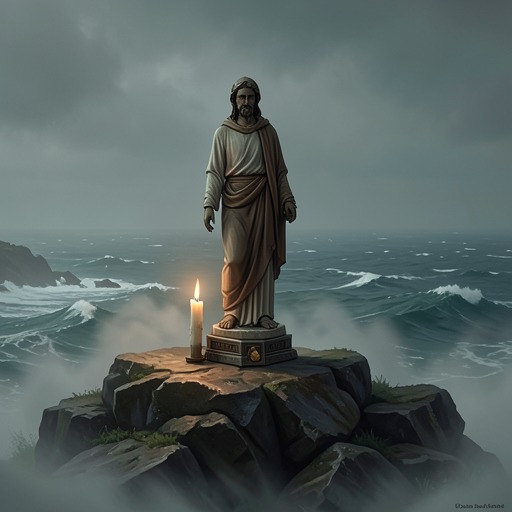
A woman named Lucia brings the statue into the room on St. Ponticus after finding it through the Internet. She explains that it took considerable effort to locate, despite the recent attention surrounding the Pope’s journey to Mexico. The statue is brightly painted and depicts Juan Diego with arms extended, the image of Our Lady of Guadalupe displayed on his tilma, and roses at his feet. The image’s details reproduce the familiar account of the miracle, but the novel also makes its artifice plain: the image is attached to the figure, and the roses are made of paper.
That mixture of devotional familiarity and ordinary materials suits the statue’s role. It does not need to be a miraculous object in itself to become important. For Oberon, it represents a saint whose story he knows and a prayer he believes has been answered; for Lestat, it evokes his own longing to be recognized as a saint. The object gathers those distinct forms of belief without resolving their differences.
Lucia’s gift and Oberon’s claim
Lucia sets the statue on a low white table and presents it as something she has gone out of her way to obtain. Oberon responds with mock affection, but when Lestat offers Lucia money for the figure, Oberon insists that it is for him and refuses to let Lestat take it. He explains that he visited the Cathedral of Our Lady of Guadalupe when the Secret People went to Mexico City. His attachment is therefore grounded in an earlier encounter with the saint’s devotional setting, not just in the statue’s appearance.
The exchange takes place amid the impending end of Rodrigo’s rule on the island. Lestat warns Lucia that the people there are in danger and urges her to leave, while Oberon tells her that the threat is real. Oberon then shoots her. He says she had been kind to him, but keeps the statue as his own; his attachment to the object persists even as he takes part in the violence surrounding the rescue. Lestat asks why he killed someone who had treated him kindly. Oberon answers that he wanted to know whether he could do it, then agrees to help confront Rodrigo. The statue is thus not a sign of Oberon’s uncomplicated goodness: it remains a devotional possession amid actions that sharply complicate that reading.
The prayer and the perceived miracle
Before setting out to kill Rodrigo, Oberon urges the others to return for the statue afterward. When Lestat asks why he cares so much about Saint Juan Diego, Oberon recalls that Lucia told him Juan Diego had been made a saint. He says he prayed to the saint for a miracle. Then, as the rescue proceeds and Lestat is present to act, Oberon suddenly interprets the events as an answer: he declares that Saint Juan Diego answered his prayer and that Lestat is the miracle.
The moment makes the statue part of a chain of belief rather than proof that the figure itself has supernatural power. Oberon prays to the saint represented by it; the crisis brings Lestat into his life; and Oberon reads that arrival through his prayer. The novel leaves the interpretation with Oberon. What is certain is the change in his understanding: the statue and the rescue become joined in his mind, so recovering it is not a trivial preference but a way of preserving the object linked to the experience he calls miraculous.
Recovery and meaning at Blackwood Farm
During the evacuation, Oberon remembers the statue and calls from the stairs that Lestat must retrieve it. Lestat promises to bring it, assuring him that the Mayfairs can provide whatever else he wants. Oberon boards, then appears again to emphasize that it is the statue connected to the miracle. Lestat promises not to forget.
After returning to Blackwood Farm, Lestat keeps that promise. He places the Saint Juan Diego statue on the table beside Oberon’s bed. Oberon thanks him warmly and says that now he will be able to sleep. He describes feeling safe, free, and able to look beyond the belief that beauty was confined to the changing sea. The statue’s final importance is therefore personal and relational: it marks Lestat’s fulfillment of a promise, and it allows Oberon to keep close the devotional object he associates with his prayer, his survival, and renewed security.